Project — 2026
grounded-copy
Output rules and a copy checker for AI agents.
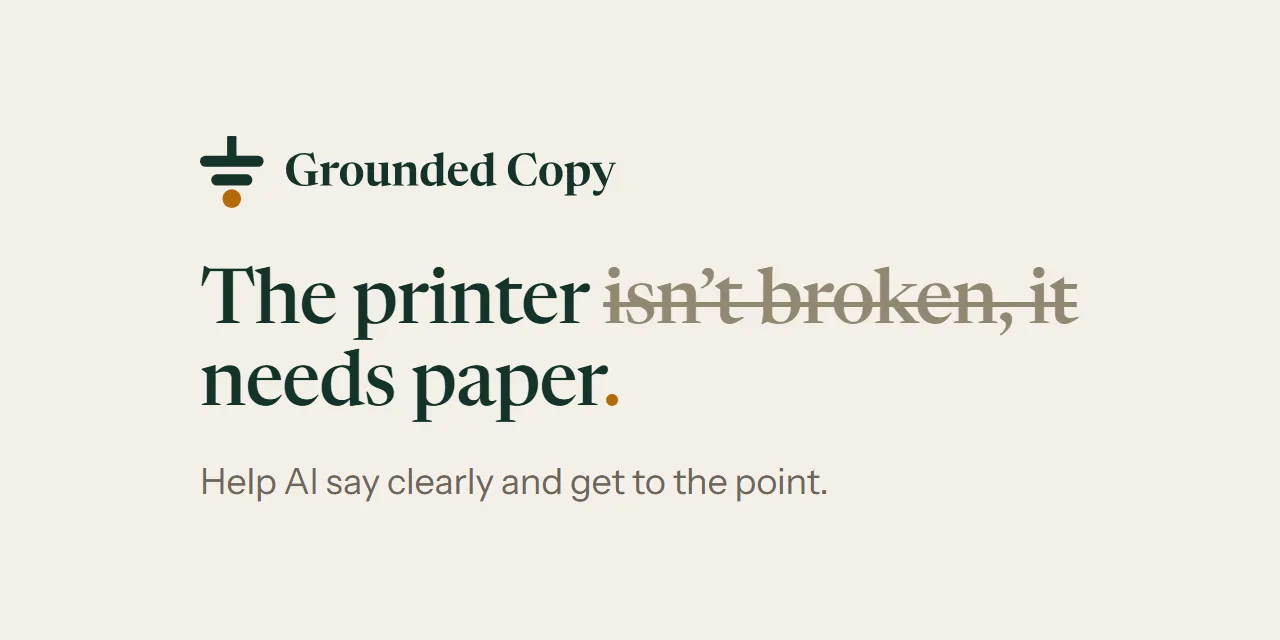
A sentence can sound finished while leaving its subject oddly out of focus. Read a product description and try to picture someone using the product: what do they click, what happens next, and what have they accomplished? The answers give the reader something to examine. They also give the writer something to be wrong about.
That is the idea behind grounded-copy. It gives an AI writing rules and checks drafts for recurring habits, including inflated claims and vague appeals to authority. Its usefulness has a clear limit: a checker can flag a phrase, but the writer still has to establish whether the sentence is true. A precise description can be precisely wrong.
A paragraph has a job
Some of the most useful recent work concerns Chinese prose. An English technical explanation can arrive in Chinese with every detail intact and still be exhausting to read. A paragraph about an upload fix might dutifully mention chunk identifiers, checksums, and retry queues. Someone waiting to learn whether they can upload a file again has a much narrower concern.
The Chinese paragraph guidance asks the writer to decide what the reader needs from the passage, then choose the facts that answer that need. For a release note, “Interrupted uploads can now resume” may carry the whole update. An engineering explanation needs the mechanism too. The amount of detail follows the purpose of the piece.
This sounds modest. It requires judgment at almost every step. A condition such as “available to invited users” changes who can use a feature and must survive an edit. A second sentence repeating the first sentence’s conclusion can usually go. Moving a long inventory into bullets leaves the work of deciding what matters unfinished.
The guidance also covers repeated sentence frames, awkward clause connections, and changes in register. These are instructions for writing and review; the checker does not currently detect them. That distinction matters whenever a passing check starts to feel like permission to stop reading.
What the tool actually does
The Claude Code and Codex plugins load the rules into the agent’s context and add reminders as the conversation continues. A portable skill carries the writing guidance to other supported agents. The saved profiles let me choose everyday prose, product copy, or turn the guidance off for work that needs different wording.
The Python checker examines a saved draft and reports matching phrases with their locations. It covers nine languages, with different depths of coverage. I still need to read the surrounding paragraph: an ordinary phrase can trigger a rule, and an awkward paragraph can pass every check. Installation instructions and the complete rules live in the repository.
The standard I want to hold the writing to is quite ordinary. After a paragraph, the reader should understand something they could explain to another person. Keeping that standard in view takes more attention than any phrase checker can supply.